




Are you ready for SYO?
Find out with this 5-minute assessment.
This short assessment will give you a low, medium or high SYO-readiness score.
At the beginning of each assessment category, you’ll see the description of a fictional city’s infrastructure, called Pineberry Park. This example is a “medium-ready” city for you to reference as a baseline.
As you move through the assessment, you’ll see your readiness score after each category, as well as your agency’s overall score at the end. Let’s get started!

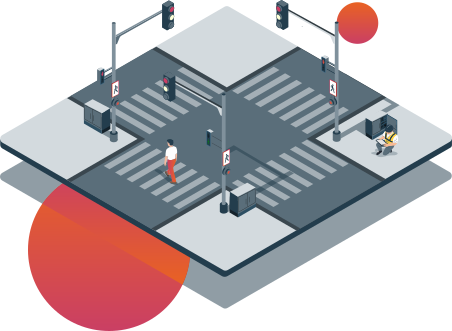
Pineberry Park has 273 intersections and 70% of them are connected.
This puts the city in the middle of the readiness curve: big enough to need centralized visibility, but still working toward full modernization.
Number of intersections managed by your agency
% of intersections connected to your network

Your agency manages a limited number of intersections, with only a small percentage currently connected. This places you at the early stage of digital operations, where many towns and cities begin. Establishing a plan to bring more intersections online gradually, over months or even years, is typically the first step toward achieving more consistent visibility and faster troubleshooting.

You have a moderate percentage of connected intersections, giving you a partial but not yet complete view of your network. Expanding connectivity, aligning communication paths, and standardizing reporting practices help agencies gain the fully unified visibility associated with high readiness.
You have a large, highly connected intersection network with consistent visibility into most field assets. Your teams already rely on real-time data, making SYO a natural fit. SYO will consolidate insights across your entire connected Synapse ITS footprint and give technicians even faster, clearer diagnostics from one centralized ecosystem.
Pineberry Park operates a mix of field networks and cabinet types with the majority of their SYO compatible monitors connected and IP addressed.
This blend reflects a city in steady transition. Cabinet types like NEMA TS2 and ATC cabinets support more modern configurations, but older cabinets limit how devices are accessed and diagnosed.
SYO compatible monitors in use
% Monitors physically connected
% Monitors with IP addresses assigned
Field network types
(Select all that apply)
Cabinet types
(Select all that apply)
How is field maintenance handled
Your field environment includes a mix of older networks, legacy cabinets, and limited monitor connectivity. Gradually increasing monitor connectivity and moving to newer cabinets can help you move toward an average readiness level, where diagnostics begin to feel more predictable and standardized.
You’ve already made notable progress with some modern network segments, some newer cabinets, and a growing number of connected monitors. Organizations at the high level often have consistent cabinet configurations and communication paths, which makes operations more streamlined and easier to manage long-term.
You operate a well-modernized field environment with newer cabinets, strong network infrastructure, and a robust number of connected monitors. Your workflows are already well-defined and efficient. SYO fits seamlessly into this level of readiness, giving you deeper insights, faster diagnostics, and a centralized operational view across every cabinet and device in your network.
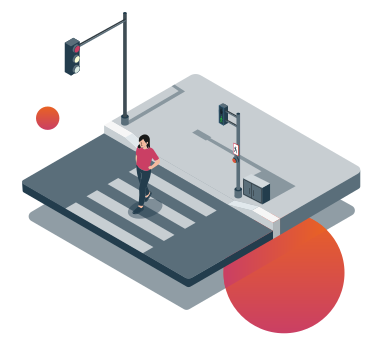
Pineberry Park maintains a moderate number of pedestrian push buttons, with a mix of APS and other older (non-APS) buttons.
Pineberry Park’s infrastructure is positioned well for future compatibility.
Push buttons in use
Push button wiring type used
Are you currently using the Polara Updater software?
Learn more about Polara’s Updater software
Your push button infrastructure has a mix of aging devices that vary in configuration. Agencies working toward average readiness often prioritize ADA-compliant upgrades to APS push buttons and consistent hardware selection so future monitoring tools can integrate more smoothly.
You have a moderate inventory of pedestrian push buttons, including some newer APS units. To reach high readiness, agencies typically standardize on a 2-wire APS push button to ensure current or future centralized control and monitoring.
You operate a large, modern, and largely standardized push button network. Your infrastructure is exceptionally well-prepared for remote connectivity, centralized monitoring, and faster detection of pedestrian-related issues.
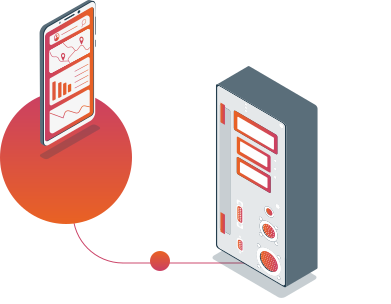
Pineberry Park uses a small but growing set of ITS applications and operates ECcom software.
This places the city at an average level of operational technology maturity.
Internet-accessible ITS applications in use
Do you currently use ECcom software?
Learn more about EDI’s ECcom software
Your ITS software usage is limited or varies between teams, and ECcom may not yet be part of your regular workflow. To reach an average readiness level, agencies often begin by identifying which tools they already rely on, where data lives today, and how teams share information.
You use a mix of ITS applications and ECcom is present in parts of your operation, though not yet fully unified. High-readiness agencies typically have consistent processes and a shared understanding of how ITS applications support their daily operations.
You operate a mature ITS application stack with strong, consistent ECcom usage across teams and intersections. Your agency already values real-time data and centralized control. SYO will amplify these strengths by unifying your tools within a single ecosystem, giving you streamlined visibility, secure workflows, and more efficient diagnostics across your entire operation.
Thank you for completing the SYO assessment and getting your SYO score. Your score represents a low alignment. As your infrastructure grows, be sure to return and see how it impacts your assessment score.
Thank you for completing the SYO assessment and getting your SYO score. Your score represents a medium alignment. We have added you to our waitlist, and a member of our sales team will contact you.
Read the case study below to see how Seminole County uses SYO™ to reduce truck rolls and signal fault triage time.
Congratulations! You received a high SYO alignment score and your city is ready to benefit from the SYO ecosystem with SYO App and SYO Web, alerts and notifications, map views and remote diagnostics.
Below, find a link to Jeremy Hancyk’s (Director, Software Sales) calendar. Schedule a meeting and begin your SYO journey.
Read the case study to see how Seminole County uses SYO™ to reduce truck rolls and signal fault triage time.